I have not been living in India for the last ten odd years. After I am back - I seem to be in a weird state of transition.
Thursday, December 11, 2008

Monday, November 17, 2008
It has been eons since I wrote my last blog. Yesterday I saw something in our garden that I think worths sharing. It was a colourful spider - the cobweb was even more fascinating. It had white zigzag marks at the diagonals. A picture says more than a thousand words (unless it is a poem of course) - so here is the picture.
I do not understand why some people hate squirrels. We have plenty of tiny squirrels in our garden. They are very timid and feed on fruits and termites. They clean themselves very often. They are playful and often hang around in pairs. Although I am no Gussie Fink Nottle (Wodehouse readers know what I am talking about), but I think they are fun to watch. Here is a little member from our garden.


I do not understand why some people hate squirrels. We have plenty of tiny squirrels in our garden. They are very timid and feed on fruits and termites. They clean themselves very often. They are playful and often hang around in pairs. Although I am no Gussie Fink Nottle (Wodehouse readers know what I am talking about), but I think they are fun to watch. Here is a little member from our garden.

Wednesday, March 7, 2007
Historic Saptagram-Tribeni
Saptagram (sapta: seven, just like septa in Latin; gram: villages) or Satgaon was an ancient port on the Ganges (river Bhagirathi to be precise, which is one of its distributaries). Around 10th century A.D. Saptagram became a major centre for trade in Eastern India. By 12th century ship from all over the known world came to Saptagram port to buy Indian spices, silk, fabric, perfumes, ornaments, and jewelry and to sell their own merchandise. Rome, Portugal, Netherlands, as well as the far eastern countries, like Java, Sumatra, and later (16th century onwards) France and Britain were connected to Saptagram through the trade-route. Believe it or not, there is still a village nearby of the Portuguese settlers from that era and their present population is about 6000. Interestingly, none of them know a word of Portuguese any more. The first church in Eastern India was built by the Portuguese in Bandel, few kilometers away from Saptagram (started : 1599, finished : 1660). Here is a stained glass work of one of the windows of the basilica.

A scholarly, yet brief review on Saptagram can be found in :
Here is a map to give you an idea about the location, although, the map of India looked very different then..

Saptagram became a centre for education and culture. Both Hindu and Buddhist scholars gathered around Saptagram. Until the Muslim invasion in 1298 it flourished as a center for pilgrimage to the Hindus. There was a huge Hindu temple on the eastern bank of the river Ganges. Zafar Khan Gazi, the general of the Muslim invaders destroyed the Hindu temple and converted it to a mosque. Chiseled statues of Hindu deities can still be seen on the back walls of the temple. I took this picture just of the west side of the temple not too long ago.

"History has many cunning passages, contrived corridors
And issues, deceives with whispering ambitions,
Guides us by vanities.." (Gerontion by T.S.Eliot)
Near the temple, there is an old banyan tree. No one knows how old it is. I sometimes wonder, how much of history has this tree witnessed! I wish it could talk.

Opposite to it flows the river Ganges. Here you see a tiny hand-made wooden boat used by a local fisherman. Some of the things did not change in the last thousand years.
and some obviously did...

Not too far from here, there are two beautiful temples. One is Hanseswari... Its unique architecture is unlike any other temple of Bengal. It does have some resemblance with St Peters Chapel of Moscow. Recently the temple underwent minor renovation. White paints were used in several parts of the temple. I like the original uncoloured red bricks rather the coloured structure. Renovation and restoration are two different words to me, and I prefer the later when it comes to old structures.

The other one is the Basudeb temple. It is a single canopied Bengal-style architecture.

The burnt-clay terracotta on the walls of the Basudeb-temple are slightly worn out with its age. A few of them have been removed (not sure by whom). Still, you can see quite a few of them. They depict stories from the Hindu mythologies. I wish I had better pictures of the terracotta than these:


As a young boy, I used to bike on the road along the riverbank. On some hot summer afternoons I would sit underneath the shade of an old tree and refresh myself with the river breeze, and hear the boatmen singing folklores from their tiny fishing boats. I wondered a thousand years ago, I would probably watch the Roman or the Portuguese or the Sumatran sailors singing some unknown melodies, perhaps the folklores from their own land. I would not understand the lyrics, but I know that they would be songs of love, or of amorous grieves and pangs. After all we are all the same...our melodies might vary, but not our feelings.

Wednesday, January 10, 2007
One afternoon we decided to visit a relative about 40-45 km away from where we live. We drove through rice fields, saw cattle grazing in the field and had a good glimpse of the country-side. Here are some pictures.
Here is a rice field. You could see goats and cows grazing there. The field close to you has already been harvested. The ones farther are ready to be reaped.

You can see some cows from close.

India is a country of peaceful coexistence and tolerance. One interesting thing about Indian roads is that both drivers and animals share them thinking that they have priority over the other. Here is an example:
 As you see, a hen is right in the middle of the road. If you use a magnifying-glass you can see a few more further away. The dog, being an intelligent animal, stayed off the road and is possibly thinking when he would get a chance to sleep on the clean road. The goats (below) are busy in their altruistic duty to prune any grass growing right next to the road.

Would you agree any less that Indians live in a very symbiotic society, where animals and men (and women, to be politically correct) share their social responsibilities, and make this earth a better place for each other?
With this I conclude this part of the blog. Any comment, question or suggestion will be greatly appreciated.
Here is a rice field. You could see goats and cows grazing there. The field close to you has already been harvested. The ones farther are ready to be reaped.
You can see some cows from close.
India is a country of peaceful coexistence and tolerance. One interesting thing about Indian roads is that both drivers and animals share them thinking that they have priority over the other. Here is an example:
As you see, a hen is right in the middle of the road. If you use a magnifying-glass you can see a few more further away. The dog, being an intelligent animal, stayed off the road and is possibly thinking when he would get a chance to sleep on the clean road. The goats (below) are busy in their altruistic duty to prune any grass growing right next to the road.Would you agree any less that Indians live in a very symbiotic society, where animals and men (and women, to be politically correct) share their social responsibilities, and make this earth a better place for each other?
With this I conclude this part of the blog. Any comment, question or suggestion will be greatly appreciated.
Monday, December 18, 2006
On the other side of the river.

One afternoon after lunch, I biked to the bank of river Ganges and asked the boatman if he would let me take my bike on his boat. Not only did he allow me, he lifted my dad's old, heavy 1953 Philips-UK bike on his shoulder, carried it, and placed it safely on the boat leaning it against a bamboo mast. I crossed the river with a few farmers who were on their way home after selling their produce in the local markets. Their baskets were partly filled with some vegetables, and rice. After crossing the river I found that there were no proper roads. There was a beautiful village path under a canopy of trees on either sides. Goats were grazing next to the path. It was very quiet. I took out my camera and took a picture. The goats were curious about my camera in the beginning, but when I was taking the picture, two of them found their neighbour Mr. Black Goat more intersting than my weird black box with a glass nose.

Thursday, November 30, 2006
Our kitchen garden
Our garden is full of fruit trees and colourful birds, butterflies and of course, flowers. Here are a few random snaps of some of them.
This is a bou-kotha-kao bird on our "amrapali" (a very sweet species of mango with tiny pits) mango tree.
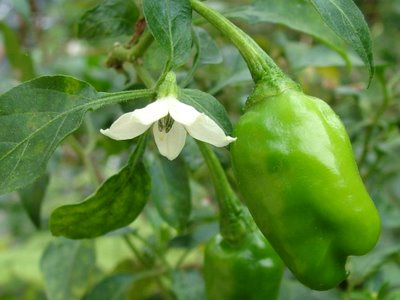
Here are some snaps from my mom's kitchen garden. Look at these peppers!
There are plenty of birds in the garden. These are a pair of judgement birds. They always fight and are very noisy. If one bird in the flock does something wrong, all the other birds punish it. I guess, that is why they are called judgement birds.
 Here is a bulbul, eating a papaya underneath a papaya tree.
 This is an eggplant flower.
 A yellow butterfly on a yellow marygold looks as if it is a part of the flower itself!

This is a bou-kotha-kao bird on our "amrapali" (a very sweet species of mango with tiny pits) mango tree.

Here are some snaps from my mom's kitchen garden. Look at these peppers!
There are plenty of birds in the garden. These are a pair of judgement birds. They always fight and are very noisy. If one bird in the flock does something wrong, all the other birds punish it. I guess, that is why they are called judgement birds.
 Here is a bulbul, eating a papaya underneath a papaya tree.
 This is an eggplant flower.
 A yellow butterfly on a yellow marygold looks as if it is a part of the flower itself!
Friday, November 24, 2006
My trip to India Nov 2006
Here are some pictures from my recent trip to India. This is a serene village in Bengal named Gopalpur. In search of some green and village scenes I biked to this place.

Here is another one: This picture was also taken in the same area. River Kunti (Koon-tee) runs through the village. Along the river, people use boats to commute: farmers bring their produce to the markets, milkmen bring milk from their farms, kids go to schools. The river is like a highway. It might be a little slower than your I-95 or Highway 1, but more economical and eco-friendly for sure. I took this picture from a rickety wooden bridge where I had to pay a toll tax of 50 paisa (little less than 1 cent) for my bicycle. Please note that no motor-vehicles are allowed on the bridge.

October-November is the harvest season. The rice-fields are bare now. The grains and the hays are stacked, and loaded on boats to the market...

..and these two boats look like a pair of slippers to me. Won't you agree?

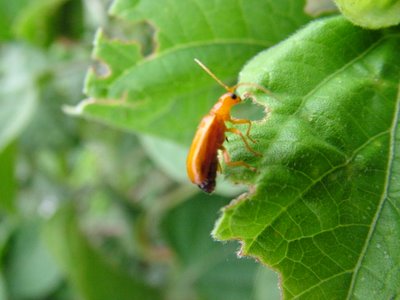
Have you ever seen a glow-worm? Have you ever seen it from REALLY close? I found a swarm of them in a village. They feed on leaves. Here is a picture. I had to push the limits of the macro mode of my camera to get this shot.
Subscribe to:
Posts (Atom)